Coordinates of an Embodied Life
I don't remember my life as one continuous story. I remember it through coordinates.
I intended to write this piece at the end of last year. My body stopped me.
Within a short span, we lost two aunts and an uncle. Our nephew was in the classroom at Brown when the shooting happened. Hearing a family member make those losses about their own discomfort, rather than what the people grieving were carrying, is what stopped me in my body. The flu followed.
Surrender is a concept I learned from John Schumacher, one of only fourteen people in the United States certified as an Advanced Iyengar Yoga teacher. I remember him talking about surrender during class, and I remember not knowing what to surrender to: my body, my thoughts, the practice, my abilities, or an ego that was building through practice. I recall feeling a sense of terror when I realized I had considered surrendering to the ego, and in that moment I froze in uncertainty.
A few years later, in my teacher training, I returned to the idea of surrender through the Sutras and learned the concept of Ishvara Pranidhana (Iyengar, 1993, Sutras II.32, II.45). In my own home practice, I began centering surrender from the start:
Begin in Sukhasana
With eyes closed
Recite "Om" three times
Recite the Invocation to Patanjali
Lower my head, eyes still closed
Recite, I bow my head to the light within and to the practice of self-study (svadhyaya), self-effort (tapas), and Ishvara Pranidhana.
I then dedicated the practice to someone, with a note of gratitude for something concrete they do to help themselves or others.
At that time, this meant surrendering to a body pumped full of fertility hormones. In November, it meant surrendering to a body filled with a mourning I still can't articulate. I recognize it now as a coordinate on my life map that changed my outlook and journey.
I think of such shifts through Merleau-Ponty's idea that the body knows before conscious thought catches up (1945, 2013). I've already mapped that terrain in an earlier piece. My life keeps taking this same shape: I return to practice whenever achievement, loss, or ego try to pull me away from myself.
Holding Three Truths (2015–2017)
We began IVF in 2015, two cycles, followed by two miscarriages. The doctor said not to run and not to exercise my core. A foot injury later that year put me in a boot. My Iyengar yoga teachers guided me through supported poses, but it wasn't enough of what my body needed. But I listened to the doctors instead of my own body, gaining weight and creating a mind-body disconnect. A sadness began to build that I could not process without movement.
Simultaneously, my professional work was gaining recognition. My director at JHU emailed me shortly after I arrived to congratulate me on a presentation I had made to the Maryland State Department of Education: "I just wanted to say congratulations and thanks for all the work you did to pull off yesterday's presentation. I had very positive feedback from both participants and the State." Similar feedback followed into the spring of the following year: "You did a terrific job pulling this together. The MSDE team all spoke very highly of your efforts. I know there was some frustrating moments on Tuesday with regard to the technology, and again with internet connectivity (that one is actually out of our control), but I'm glad they were able to be turned into teachable moments for the attendees. I had several old friends and colleagues in the audience, and they all echoed the same sentiment, that they are excited to move forward."
Apart from this, I had recently published my first book on preschool inclusion (Gupta, 2014), helped design and publish results from the inaugural National Early Childhood Special Education Leadership Summit at the Division for Early Childhood's Annual Conference (LaRocco et al., 2014), with the findings later published in Young Exceptional Children (LaRocco et al., 2015), and co-authored a technical assistance brief on Maryland's data use partnerships (Ruggiero et al., 2016).
I struggled to hold all three truths at once: miscarriages that I had not yet fully grieved, professional recognition, and a growing discomfort in producing to meet others' expectations. It would be another decade before I would read about the Buddhist term upekkha, the ability to know your position and also hold many perspectives at once without picking a side.
One of the things I did then to focus on others was to find interesting cards and knick knacks for family and friends, sometimes on birthdays but mostly for fun with no occasion in mind. This was my intention after that spring training when my husband and I were exploring a nearby town and walked into an eclectic hobby shop. I beelined to the card carousel eager to find something inspiring and unusual. And then I stopped the carousel abruptly.
I saw a card with a watercolor of a girl, vibrant pink waves radiating outward from her belly to the shape of both a flower and a dress. She was barefoot, her hair was wavy and blowing in the wind. Her eyes were closed. The colors were vibrant and there was a movement in the card that communicated both stability and whimsy. She was in bloom. Seeing her, I realized I was burying my grief in my work and it was making me deeply unhappy. The outward presentation of success was a mask for the sadness I was feeling and couldn't access without movement.
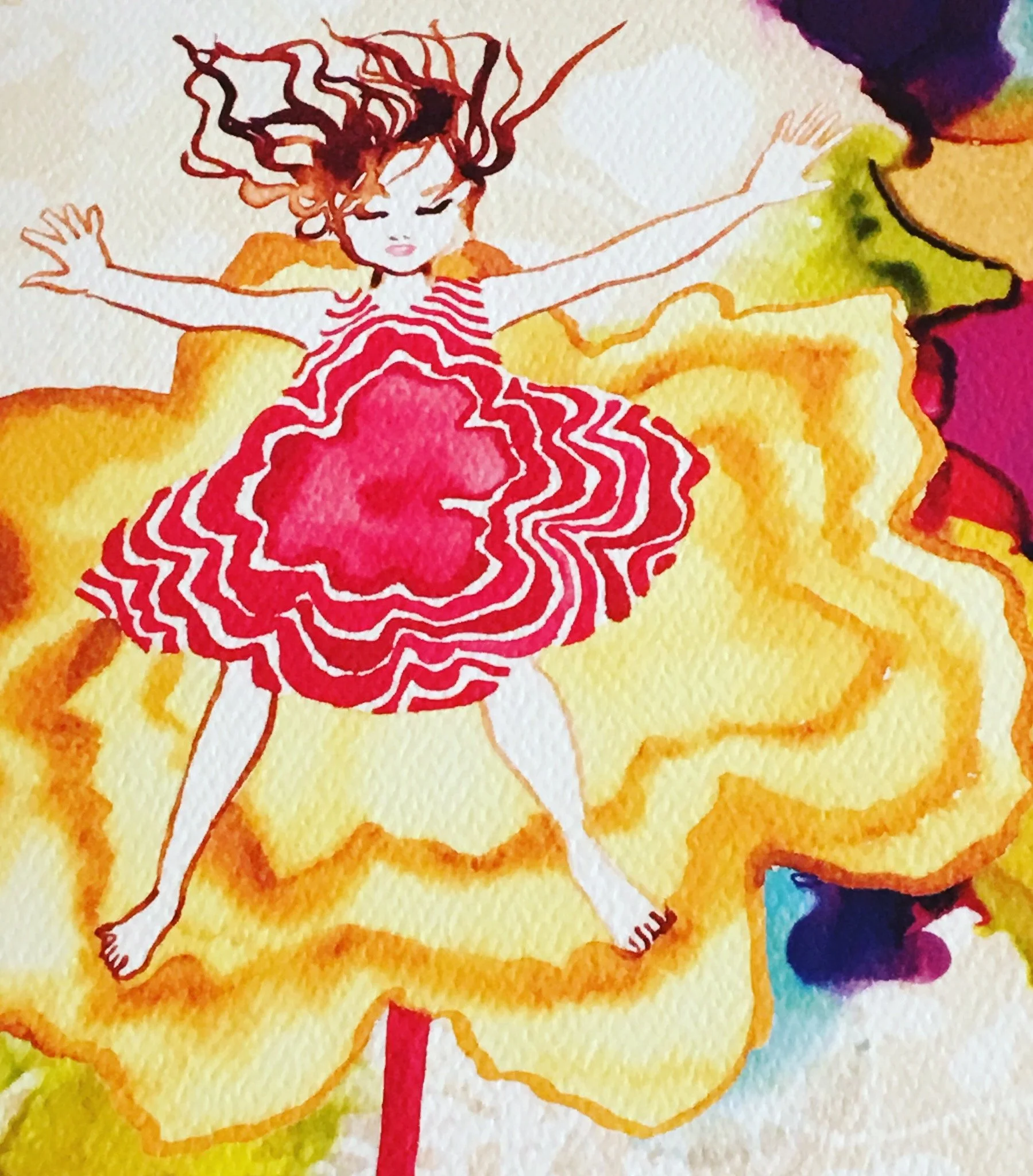
Artist unknown. Watercolor illustration of a girl with wind-blown reddish-brown hair, eyes closed, arms outstretched, wearing a red-and-white striped dress with a magenta-pink center, standing barefoot atop a large yellow-orange flower shape on a red stem, against a loose wash background of yellow, green, magenta, and teal.
Several months later, I resigned from my position and the partnership work I truly loved to focus on accessing that grief. When I announced my resignation to my partners and why I was resigning, I was heartened to receive responses that propelled me into the liminal space I needed to become a whole person again. One state-level systems leader wrote back: "I just wanted you to know how much I have enjoyed working with you over the past year or so. We did have fun!! I want to commend you for your exceptional work in keeping all the balls spinning for the XXX roll out, thank you! I so understand and respect your decision and just wish you all the best in starting your family. Please stay in touch and thanks again for all you contributed in improving outcomes for young children with disabilities and their families!"
Another systems leader wrote: "I am so sorry to see you go. I wish I had had more time and opportunities to work with you, maybe in the future. That being said, I completely understand your decision and I wish you and your family all the very best of health and happiness! I am very sorry to hear of your losses and all you have gone through with that. I pray that your decision to focus on your family and health leads to peace and overwhelming joy with all your hearts' desires fulfilled!!"
I had chosen me instead of the work. And my colleagues’ light, conveyed through support and well wishes, helped me begin a healing process that would continue for years.
Finding the Sankalpa (2018–2019)
We moved to New York City in 2018. It was where we had gotten engaged in 2006, the city we visited most often, where family and friends were, and where we both felt most alive.
I was continuing my commitment to inclusion through traditional faculty positions at George Washington University and Hunter College. It wasn't the exact work I wanted to do, but it provided flexibility to continue the multitude of appointments IVF required. More importantly, with each job change, my benefits renewed along with the number of IVF cycles available to me. This time I chose a slightly different path. I was working, and alongside it, prioritizing movement through a daily Iyengar yoga practice and a new weekly practice in the women's class at the Iyengar Institute of New York.
The unintended benefit of this approach was having a space to work through the growing sense of not belonging with colleagues who were seen as difficult. In conversations, it became clear that the expectation was top-down standardization rather than designing from the margins inward. A senior colleague's visible displeasure with my comment about journals in EI/ECSE perpetuating Anglo-centric norms made clear my place at Hunter wouldn't last. I noticed I was gripping my belly in that interaction.
Later that week, I spoke with my Iyengar yoga teacher, eager to address my tendency to grip my belly. I hoped she would share a correction or a series of poses that might help me reduce this tendency. Instead she offered me an image: think about your belly as an ocean, cavernous and flowing. This image became my sankalpa, redirecting not just my practice but how I moved through any discomfort, physical or professional.
Thereafter, in my practice, I worked on creating space in the inner groins through small adjustments in utthita trikonasana. I rooted through the four corners of my feet, and that grounding helped me release the hardening in my belly and feel the waves return (Apt, n.d.). I thought often about the watercolor girl during those sessions.
That same shift helped me re-root in my long-standing belief in inclusion, which was now extending into an effort to create practical and accessible materials for the practitioners expected to practice it. I started writing like I had never done before, about teaching graduate students, creating assignments, reflective practice, mapping biases, and exploring discomfort physically and intellectually, and that writing, grounded in my embodied practice, was empowering in a way I hadn't expected. I was now breathing during my long writing sessions, whereas in the past I had observed myself holding my breath trying to write in a style that no teacher or family would want to translate.
I used my research funding to enroll in the Faculty Success Program with the NCFDD to take this approach further and explore avenues for publication. I embraced the program's space to reflect, and I revised my focus, through my new Iyengar home, my academic home, and this program, understanding that I needed to focus on the self as it interacted with the larger system. This program and my renewed focus became a new coordinate on my map, propelling me into a line of inquiry where self-study became the other side of the systems coin I had long been trained in, where I knew now, through my embodied practice, that both needed to coexist to navigate complex ecologies. This is when I began to feel svadhyaya in practice: self-study as a rigorous first-person method, not a softer substitute for systems analysis (Varela & Shear, 1999). And that realization brought me compassion for the colleagues who were going out of their way to discredit me and my work.
My first two self-study pieces were published in the spring of 2019 (Gupta, 2019; Gupta, 2019), and with their publication, I was reminded of the watercolor girl at a Holi festival. A flash of colors before my eyes prompted me to stand up and do a cartwheel. My arms went down, my legs went up, my body radiating outward from my center, just as she was. I could feel the prana moving through me like an electric energy, and I landed with joy and hopefulness. I was forty-one, and my mind and body were reconnected.
Inscribing the Sankalpa (2019–2020)
It was my second year at Hunter, and it was clear I was not fitting into a particular mold of what they wanted a faculty member to be and how I should write. More importantly, their expectations conflicted with my core belief in inclusion. I was increasingly frustrated with the lack of applied work available on inclusion for families, teachers, and leaders I was working with, and I didn't understand why special education faculty were not open to work that would be accessible to the very people the systems served.
Feeling the growing divide, I decided to create a daily reminder of acting from my core, and in January 2020 I found myself sitting in a chair at a tattoo studio in the East Village with the watercolor girl in my hand.
Inscribing her on my arm became a visual sankalpa, not giving something up, but committing permanently to the self underneath the ego. Surrender like this is acknowledged in Buddhism as a gain, not a loss, the self growing more durable exactly where the ego learns to let go (Epstein, 2018). It helped me write the practical, accessible pieces and also write the expected pieces for peer-reviewed journals (see table below).
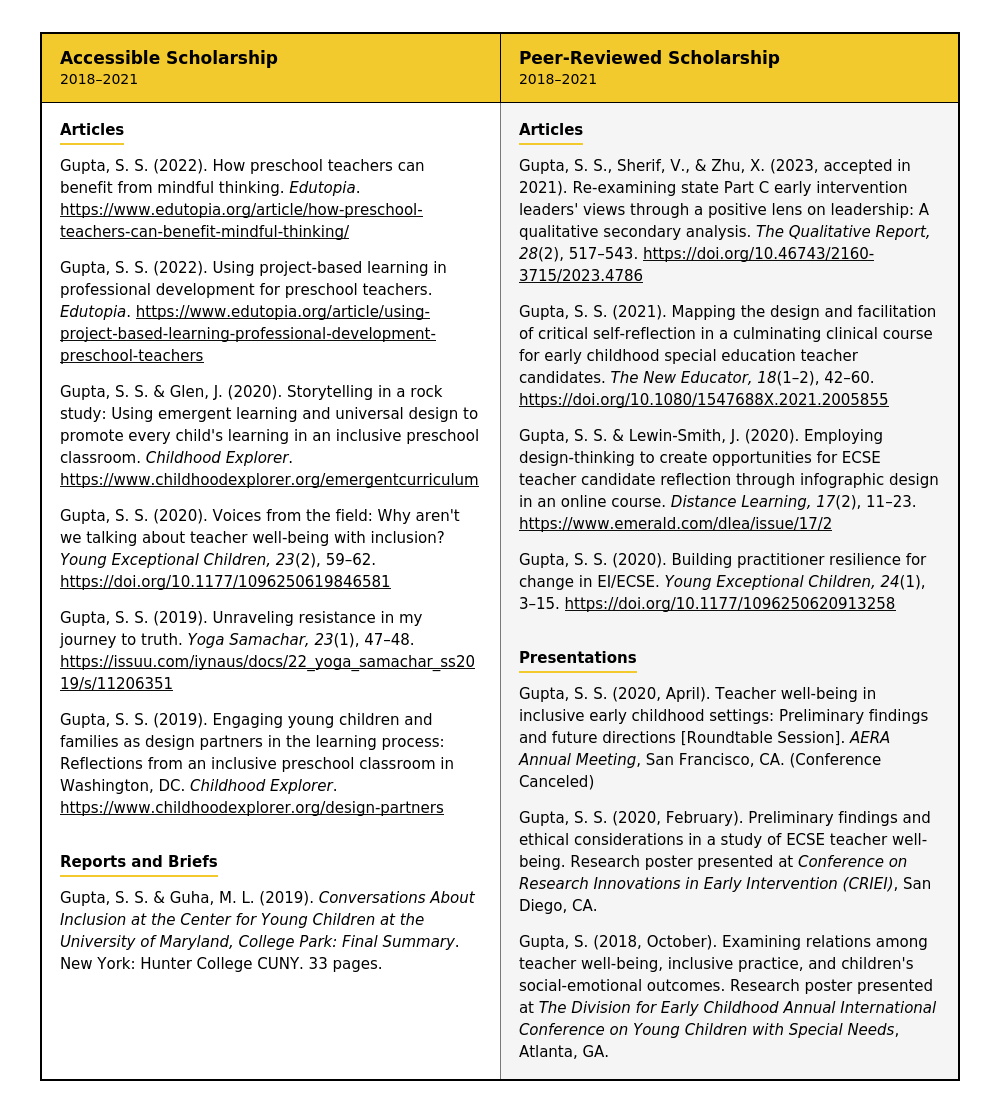
Table comparing accessible scholarship with peer-reviewed scholarship, both 2018–2021, listing full citations organized by Articles, plus Reports and Briefs or Presentations.
In the end, it didn't matter. I didn't belong in that system anyway, and staying would have meant ongoing friction and exclusion.
It brought me back to an earlier coordinate, my experience with Milo, that had prompted my journey into special education. I was devastated watching leadership exclude him because he didn't fit. Now I was holding my own exclusion in the same way. I wasn't condoning it, but I was seeing it, and the people executing it, for what it was. I had come full circle.
Embodied Sankalpa (2025)
In the years between Hunter and 2025, I experienced so much love. My practice brought me a beautiful family and a renewed professional focus on systems work through a self-study focus. I had worked at a college I had long wished to be a part of, and partnered with a public agency and people I loved working with.
In the spring of 2025, we took our daughter to the Bahamas. She asked me if I could do a cartwheel. And I did it. For her, for us, right there on the beach where she was pretending to be scared of the surf she was running in and out of with ease.
I know now that the cartwheel is not a metaphor. It is what my body does when my practice is grounded and I am where I need and want to be, in an embodied life, fully present and able to hold my stance while seeing other positions without taking a side.
Upekkha (2026)
Earlier this month, another aunt passed away, the one who had helped us with wedding shopping in India in 2007 and selected my husband's kurta. I last saw her in September 2024. She was in her mid-eighties, and she told her family she wouldn't leave until she saw my daughter, which meant she insisted staying another night.
When she passed, I didn't feel grief so much as fullness, with the memories of how much she had helped us, the stories I recalled her telling us about my grandparents' love, and how incredibly strong and full of resolve she was into her late eighties.
On the day she died, I practiced vipirita karani for an extended period of time as my way of honoring her and the light she brought into our lives.
References
Apt, M. (n.d.). Trikonasana. Yoganga.https://yoganga.com/articles/trikonasana/
Cook, K. (2021, December 10). Iyengar yoga evening practice. Desa Yogi Iyengar Yoga.https://desayogi.com/iyengar-yoga-evening-practice/
Epstein, M. (2018, January 31). Building a better self? Lion's Roar.https://www.lionsroar.com/building-a-better-self/
Gupta, S. S. (Ed.) (2014). First steps to preschool inclusion: How to jumpstart your programwide plan. Brookes.https://products.brookespublishing.com/First-Steps-to-Preschool-Inclusion-P1236.aspx
Gupta, S. S. (2019). Unraveling resistance in my journey to truth. Yoga Samachar, 23(1), 47–49.https://issuu.com/iynaus/docs/22_yoga_samachar_ss2019/49?e=50&o=1
Gupta, S. S. (2019). Engaging young children and families as design partners in the learning process: Reflections from an inclusive preschool classroom in Washington, DC. Childhood Explorer.https://www.childhoodexplorer.org/design-partners
Gupta, S. S. (2025). The myna bird knows her name. Lion's Roar.https://www.lionsroar.com/the-myna-bird-knows-her-name/
Gupta, S. S. (2026, February 19). When supporting families and supporting teachers aren't separate problems. Ecological Learning Partners LLC.https://ecologicallearningpartners.com/blog/when-supporting-families-and-supporting-teachers-arent-separate-problems-2care
Gupta, S. S. (2026, March 17). Mapping the terrain: Ruptures that have revealed spaciousness and light. Ecological Learning Partners LLC.https://ecologicallearningpartners.com/blog/mapping-the-terrain-ruptures-that-have-revealed-spaciousness-and-light
Iyengar, B. K. S. (1993). Light on the yoga sutras of Patanjali. Thorsons.
LaRocco, D. J., Bruns, D. A., Gupta, S. S., & Sopko, K. M. (2014). National early childhood special education leadership summit: Final report, February 2014.
LaRocco, D. J., Sopko, K. M., Bruns, D. A., & Gupta, S. S. (2015). Voices from the field: A national early childhood special education leadership summit. Young Exceptional Children, 17(4), 28–31.https://doi.org/10.1177/1096250614544226
Lingo, K. J. (n.d.). How equanimity powers love. Lion's Roar.https://www.lionsroar.com/how-equanimity-powers-love/
Merleau-Ponty, M. (2013). Phenomenology of perception (D. A. Landes, Trans.). Routledge. (Original work published 1945)
Ruggiero, T., Gupta, S., Nicholas, A., & Mauzy, D. (2016). State spotlight on data use, Maryland: Establishing partnerships to build data use capacity. DaSy Center, SRI International.https://dasycenter.sri.com/downloads/DaSy_papers/Maryland_Spotlight_Data_Use_FINAL.pdf
Varela, F. J., & Shear, J. (1999). First-person methodologies: What, why, how? Journal of Consciousness Studies, 6(2–3), 1–14.
Sarika S. Gupta, Ph.D., is the founder of Ecological Learning Partners LLC, where she uses contemplative mapping to help learning communities navigate self, practice, and systems.