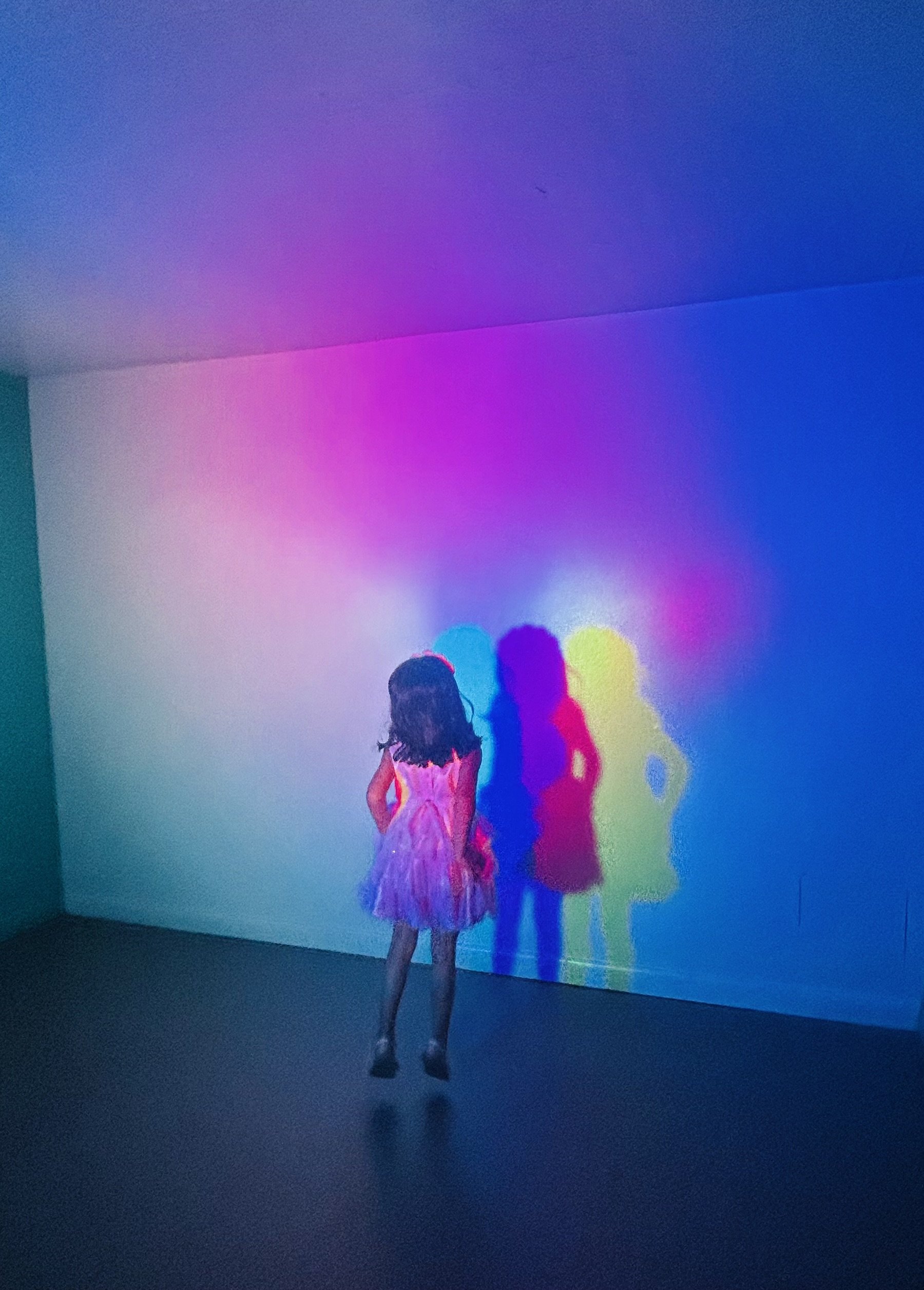
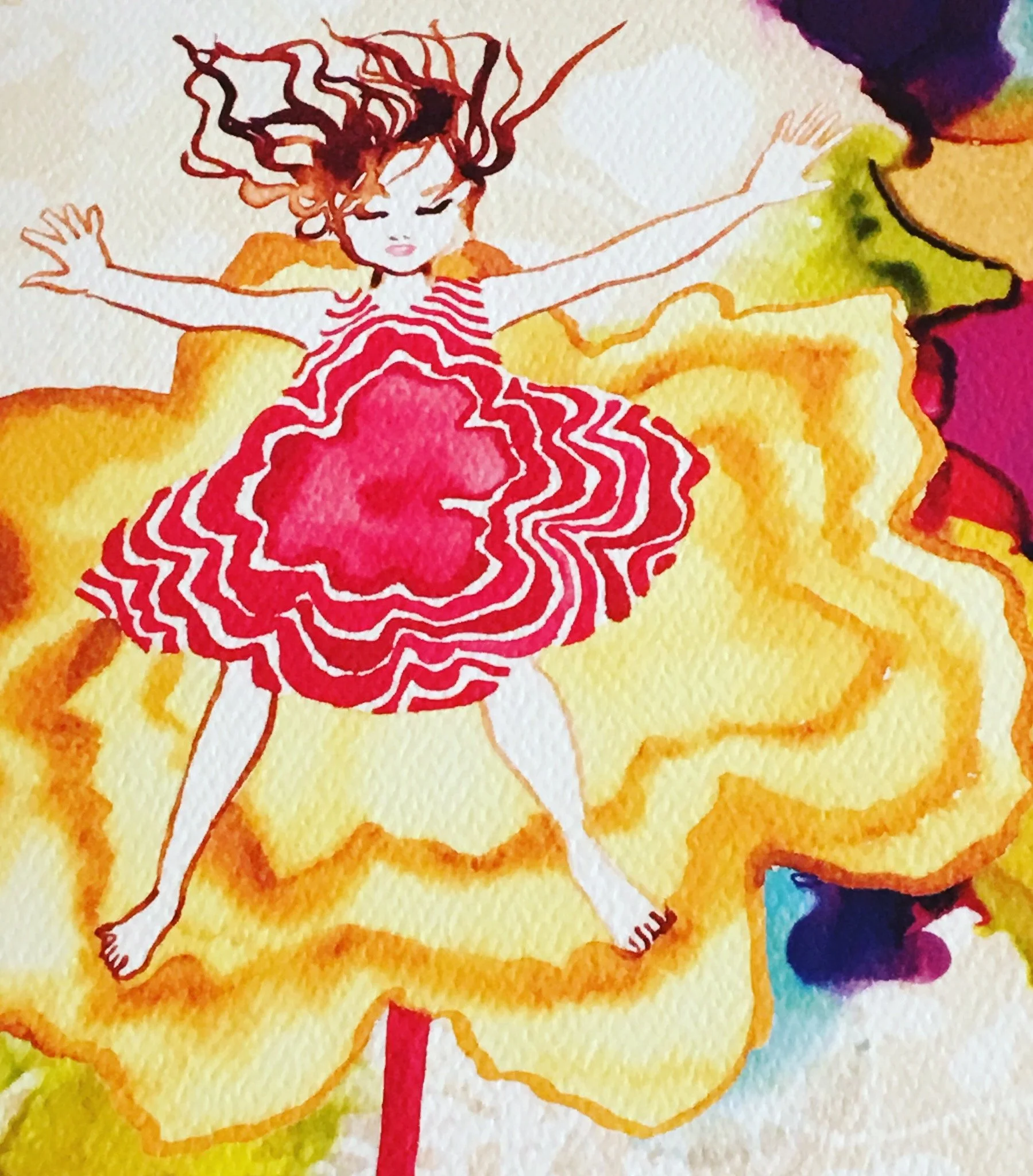
Points of Light and Nodes: Mapping an Ecology of Becoming
Last week, my daughter asked me what I want to be when I grow up. She'd already answered her own question: a singer, on a stage, by herself, when she's older, because she's shy right now. I told her I was a teacher and a professor. Like most five-year-olds, she wasn't impressed with the titles, though she has asked me before, "Mommy, you used to be a teacher like Ms./Mr. ___?" She asked me again what I want to be, giving me examples from her book ABC, What Can She Be? by Sugar Snap Studio. I said I want to help people make maps.
She stopped me. "You're a treasure keeper when you make maps for people, Mommy. You're a treasure keeper because you love people."
This past year I've been mapping my personal and professional trajectories to better understand how lived experience, relationships, and institutional conditions shape who we become as practitioners (Gupta, 2025–2026). I've been developing a contemplative mapping practice that brings together life mapping, situational mapping, and practice mapping to trace those connections.
A pattern began to emerge as I accumulated maps. My development was shaped less by individual events than by relationships that either expanded or constrained my movement. Some relationships opened new ways of seeing, thinking, and becoming. Others interrupted, redirected, or temporarily arrested my trajectory. Mapping made these patterns visible, helping me recognize that growth is not simply the result of personal effort but of the relational conditions that make movement possible.
A point of light is a relationship that opens something forward. A node is a relationship that arrests movement. Sometimes something else emerges from that stillness. Sometimes the arrest is the whole story.
Mapping the Terrain of Relationships
Here's what a point of light looks like in my own terrain. My first co-teacher was a Bank Street College graduate and an artist. She taught me to ask about children's work rather than assign meaning to it. Instead of looking for a familiar symbol, a flower or a tree, and praising the recognition, she taught me to prompt children with "Tell me about your artwork" or "Tell me about your painting." I learned later, in my special education graduate coursework, that this behaviorally reinforced the child's process. It's how I've approached my professional career ever since, as both a constructivist and a behaviorist.
Not everyone met that same practice with the same openness. A dissertation committee member told me a person couldn't be both a constructivist and a behaviorist. She didn't ask me why I held this belief. I smiled, because I already knew it was possible. She was a node, and she was also the committee member who told me evaluation work wasn't rigorous. Evaluation is now the focus of her work. Being told no lights something in me, but a spark alone doesn't build anything. It takes someone willing to hear the idea, and it takes me knowing how to say it clearly enough for that to happen. That reciprocity is what I now look for when I map whether a relationship is a point of light or a node.
In my second teaching position, in an inclusive classroom, I experienced both again. A point of light encouraged me to submit my first proposal to an international conference. We were accepted and traveled as a teaching team to present in California. A related-service professional without teaching credentials or a background in curriculum or constructivist practice monitored and reported my teaching practices to the director.
As I mapped these experiences, I began to see patterns in how relationships shape movement across my professional terrain. Some relationships create openings, expanding what I can see, imagine, and practice. Others create moments of stillness, where movement is slowed, redirected, or requires a different kind of response. Through this mapping process, I began naming these relational patterns as points of light and nodes.
The more I mapped these experiences, the more I saw that relational patterns are continually shaping practice, but we rarely have ways to make those patterns visible. This is a challenge for a field that names relationships as central while still lacking accessible methods for exploring how relationships actually shape the work we do.
The Physics of Stillness and Light
I loved physics and biology in high school. I still think about their concepts and vocabulary to explain what I see in my own life.
This is the lens I used to name a point of light and a node in my professional terrain: if you think of light as a wave, a standing wave forms when two waves traveling toward each other meet and overlap. Physics describes this as points of destructive interference and points of constructive interference along the same medium (OpenStax, 2016). Some points along that wave stay still. These are the nodes, places where the movement cancels itself out completely. Between them are the antinodes, where the wave reaches its greatest height. Neither exists without the other. The stillness gives the movement its shape. Without both, the pattern disappears.
This idea echoes my earlier writing about yogasana, where I explored how opposing forces create the conditions for practice (Gupta, 2019). It prompted my continued study of what becomes possible when we stop treating tension between forces as something to resolve and instead learn to experience what emerges from holding both.
Living systems offer another way to understand the node. In a plant stem, the node is not an absence of growth; it is the place where growth organizes. New leaves and branches emerge from that stillness. The same pattern appears in the body, where movement slows long enough for the system to notice, examine, and respond. The stillness is not outside the movement. It is part of what allows the whole system to continue.
This matches what I've lived through professionally: the nodes in my map were never empty. They were where something slowed down long enough to be examined, even when what I wanted, at the time, was only to keep moving toward the light.
My yogasana practice taught me this before I had language for it. Patanjali names this directly in Sutras II.33 to II.34: paksa and pratipaksa, opposing conditions that the practice asks us to recognize rather than resolve one away (Iyengar, 1993). Asana is where I access that recognition in the body, not as an abstract idea but as something I have to hold physically, one side against the other, until I can feel both at once. Embodiment gives this kind of mapping something language alone can't: a place to actually feel two true things at the same time, instead of choosing one and calling the other a mistake.
Nodes quieted me and stalled my forward motion. Points of light expanded my movement. The map holds these two opposites, stillness and light together. Holding both is what makes this map a usable tool for navigating these opposing influences.
The Ecology of Relationships
The protective factor is knowing who you can count on. Knowing who to call is not just about having relationships; it is about knowing which relationships create the conditions for reflection and movement. Resilience is not something we carry alone; it depends on what our relational and physical environments make available under stress (Ungar, 2011). But connection alone is not enough. Rose (2002) distinguishes support-seeking from co-rumination, where repeatedly revisiting a problem can deepen closeness while also deepening distress. The difference is not whether we reach out; it is whether the relationship creates space for reflection and movement or keeps us circling the same experience. Embodied practice and mapping build the awareness to recognize that difference.
That grounding is what embodied practice and mapping build over time: enough self-awareness to know the difference between connection and unload. None of the three mapping types gets there alone. Bronfenbrenner (1977) gave the field its language for the nested systems a person moves through: microsystem, mesosystem, exosystem, macrosystem, chronosystem. Vélez-Agosto and colleagues (2017) includes culture in the macrosystem as a force acting on people from a distance. It is inside the microsystem, in what actually happens between people day to day.
That dissertation committee member's certainty is the shape I now recognize elsewhere: someone holding a line they once had to survive, rather than asking whether it still serves the people coming after them. Mapping is what lets me see the points of light and the nodes clearly enough to move through the terrain with some grace and agency.
I often feel change in my body before it is announced. I feel it before a change in leadership or a shift in direction. Mapping shows me where the points of light and the nodes are, so when that feeling shows up, I already know who to call.
Holding Many Maps at Once
A treasure keeper's work does not stop at one map. The next part of mine is learning how to hold many at once, without losing what makes each one true, and to discover what becomes possible when those maps are brought into conversation across contexts.
_____
References
Bronfenbrenner, U. (1977). Toward an experimental ecology of human development. American Psychologist, 32, 513–531.https://psycnet.apa.org/doi/10.1037/0003-066X.32.7.513
Gupta, S. S. (2019). Unraveling resistance in my journey to truth. Yoga Samachar, 23(1), 47–48.https://issuu.com/iynaus/docs/22_yoga_samachar_ss2019/s/11206351
Gupta, S. S. (2025–2026). Mapping from the margins [Blog series]. Ecological Learning Partners LLC.https://ecologicallearningpartners.com/blog
Iyengar, B. K. S. (1993). Light on the Yoga Sutras of Patanjali. Thorsons.
OpenStax. (2016). University physics volume 1 (Section 16.6, Standing waves and resonance). OpenStax.https://openstax.org/books/university-physics-volume-1/pages/16-6-standing-waves-and-resonance
Rose, A. J. (2002). Co-rumination in the friendships of girls and boys. Developmental Psychology, 38(6), 1830–1843.https://doi.org/10.1037/0012-1649.38.6.1830
Ungar, M. (2011). The social ecology of resilience: Addressing contextual and cultural ambiguity of a nascent construct. American Journal of Orthopsychiatry, 81(1), 1–17.https://doi.org/10.1111/j.1939-0025.2010.01067.x
Vélez-Agosto, N. M., Soto-Crespo, J. G., Vizcarrondo-Oppenheimer, M., Vega-Molina, S., & García Coll, C. (2017). Bronfenbrenner's bioecological theory revision: Moving culture from the macro into the micro. Perspectives on Psychological Science, 12(5), 900–910.https://doi.org/10.1177/1745691617704397
Sarika S. Gupta, Ph.D., is the founder of Ecological Learning Partners LLC. She uses ecological mapping methodologies to understand complex educational systems, with particular expertise in early childhood education and teacher preparation.