On Containment and Embodied Inquiry: The Practice We Assume in Teacher Preparation
I have been circling around the word containment since 2022.
In April of that year, I had dreamt about a large vessel, several stories high with cascading green grass that was neatly manicured. As the vessel swirled down into a point, I noticed moss arranged in diagonal patterns angling downward. I remember feeling as if I was in a helicopter, flying around it, examining its structure from all sides, panning it slowly from top to bottom. The vessel was not receiving anyone or anything. It felt peaceful and serene.
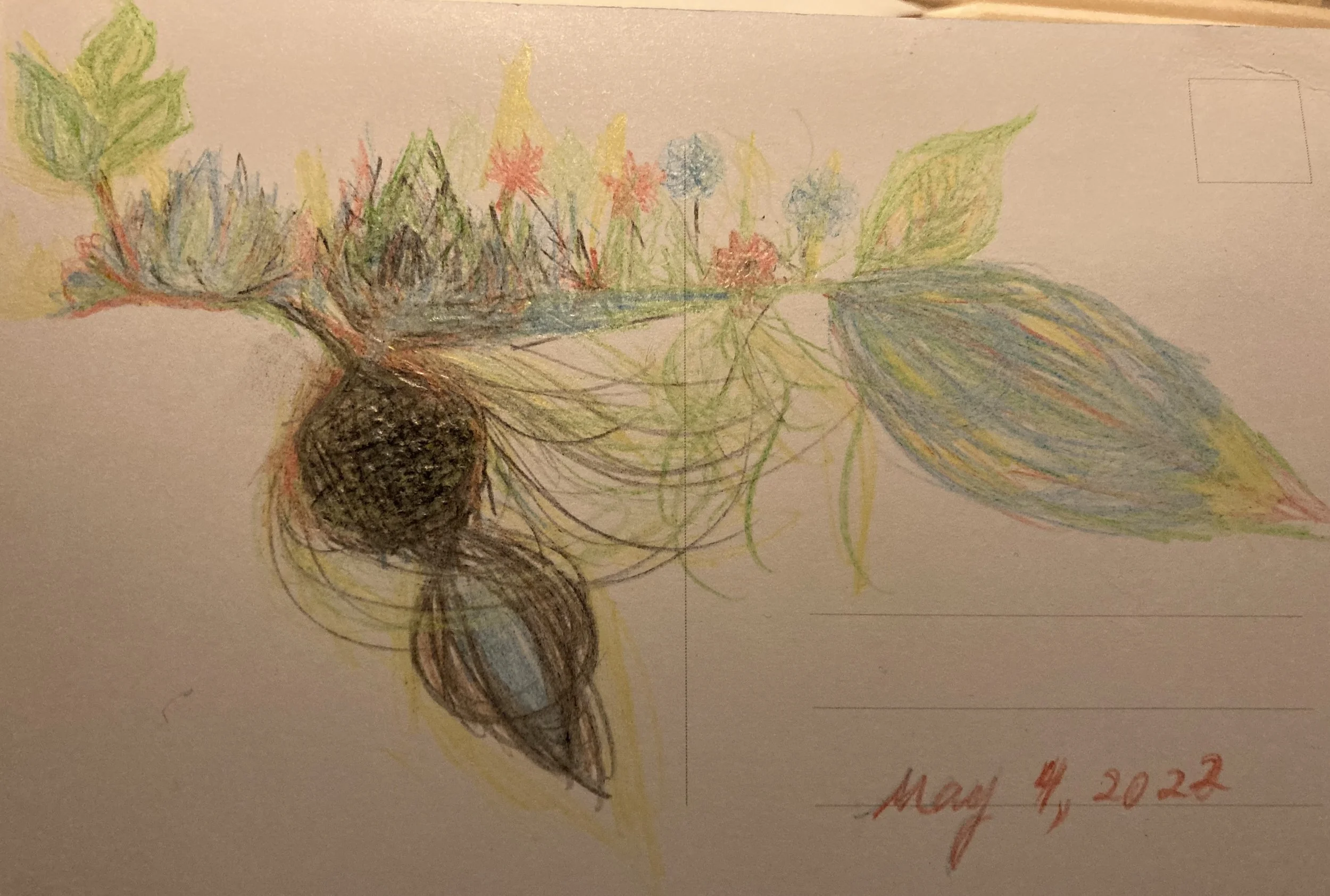
Two and a half weeks later I was at dinner on my own, a practice we intentionally created toward the end of the pandemic with a one year old to re-create space for thinking and being. After ordering my drink, the waiter, to my pleasant surprise, handed me a postcard and five short colored pencils - red, yellow, green, blue, and black. I considered what to draw and nearly an hour later, I looked down to see a dark root flowering above the ground. The root itself was dense, crosshatched, weighted, with flowers and a seed pod reaching upward and outward from it. I looked at it for the remainder of that dinner, eager to understand what it represented. And on the walk home, I knew in my bones that I had drawn the root that needed to be addressed before I could inhabit the vessel I had dreamt about.
I have long relied on movement, in various forms, to explore my emotions and my thoughts: roller skating, ice skating, tennis, skiing, sketching, writing, Indian dance forms, poetry, and running rank among my favorite activities. And rather than sitting down for long dinners with friends, I’d much rather hike, walk, canoe, or dance to connect and catch up.
Even though I was on my own that night, the drawing reminded me that I needed to consciously rebuild movement into my daily life, not set it aside, especially with a one year old who would soon be navigating the same highly verbal and written world I was living in.
It also reminded me of what happens when that space is not created. In the ecologies I grew up in, in extended family circles and in groups of friends in and beyond school, when accumulated emotional weight went unprocessed, it tended to move all at once, explosively and externally directed. The return from that is agonizing, longer and much harder than anyone expects, pushing resilience farther and farther away.
The easy explanation is that sitting with oneself is uncomfortable, and discomfort alone keeps people away. But I have been wondering whether that explanation is sufficient, and whether it misses a harder question.
For me, the question is not whether sitting with oneself is uncomfortable. The question is whether we were ever taught a sustained practice that creates the space to explore what we are thinking and feeling, or whether that capacity is simply assumed.
This question solidified for me last spring when my daughter performed in her first dance recital. She had been taking tap and ballet for over a year, and we thought she might finally be ready for the stage. Until then, she had needed 10-15 minutes to release me before class, and for many of those classes I sat with her inside the room. When she finally started dancing without me present, she created a rule: I wasn’t allowed to watch her dance. The only place I could sit out of view was the dressing room, so the other parents joined me in celebrating her independence by sharing videos and pictures and updates on what she was doing, and that she was doing it well, and on her own.
The studio scheduled a dress rehearsal the day before her recital. From my own experience dancing, dress rehearsals were something I looked forward to. I grew up with Indian dance forms, raas and garba and bhangra, and we did everything from casual shows to intercollegiate and national competitions. Across all of it, the rehearsal was where everything came together: who stood where, how we moved in relation to each other, who would cue the transitions. It was time to practice steps, finalize arrangements, and chat with friends. We were attuning to each other through movement, as a team, and as friends. That preparation was what made me feel comfortable and confident on stage, regardless of what we were preparing for. I was glad she would have the same chance before her first recital.
My husband and I brought her together, dressed in her costume. We knew there would be wait time so along with snacks we brought her notepad and her markers, as we do everywhere with a child who began drawing at the age of 1 and has been drawing with every conceivable art utensil since.
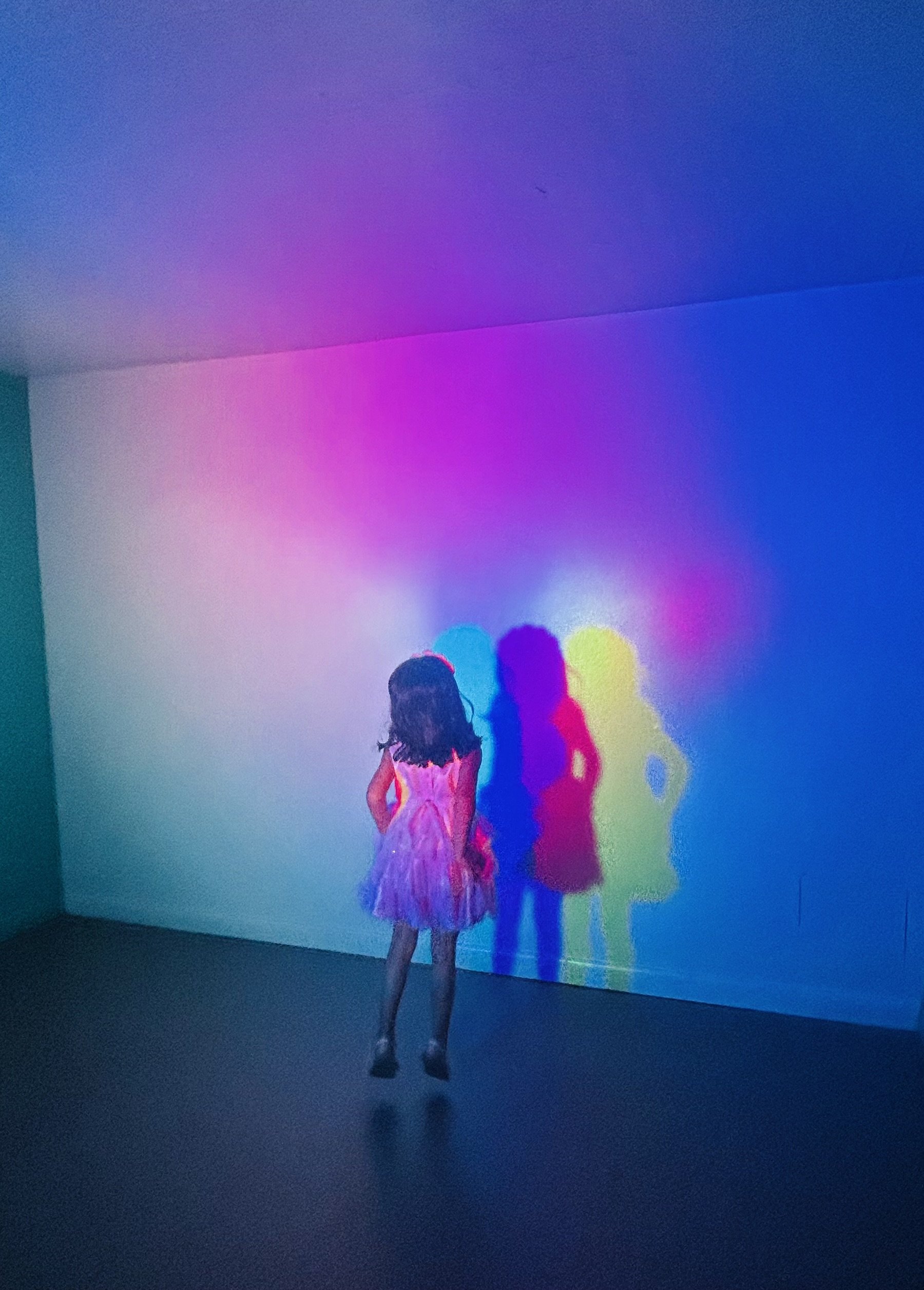
The technicians began working on the lighting controls soon after the rehearsal started. Suddenly the theater went dark, and my daughter of course asked what was happening. We talked her through who was changing the lights and why as she sat quietly between us staring down at her sketch pad. When I looked down at her paper, I saw her filling her page with a very large sad face. She quickly turned the page and drew another, then another. Despite our reassurance that this was part of preparing for the show, she was drawing what she knew before she could say it. She clung to the pad and continued drawing for the duration of the rehearsal.
The next day, unsure of whether she’d be anxious once again, we packed the sketch pad and markers in her costume bag. This time, instead of sitting with us in the auditorium, she would accompany her teachers backstage where they would have snacks and color while they waited for their time on stage. Not only did she willingly go with her teacher, she also performed on stage without our prompting. We were so proud of her (even after learning that she refused to wear the tap shoe and hair bows!). She did it. And we know the rehearsal and space to process what would be happening on stage during the show was key in her success.
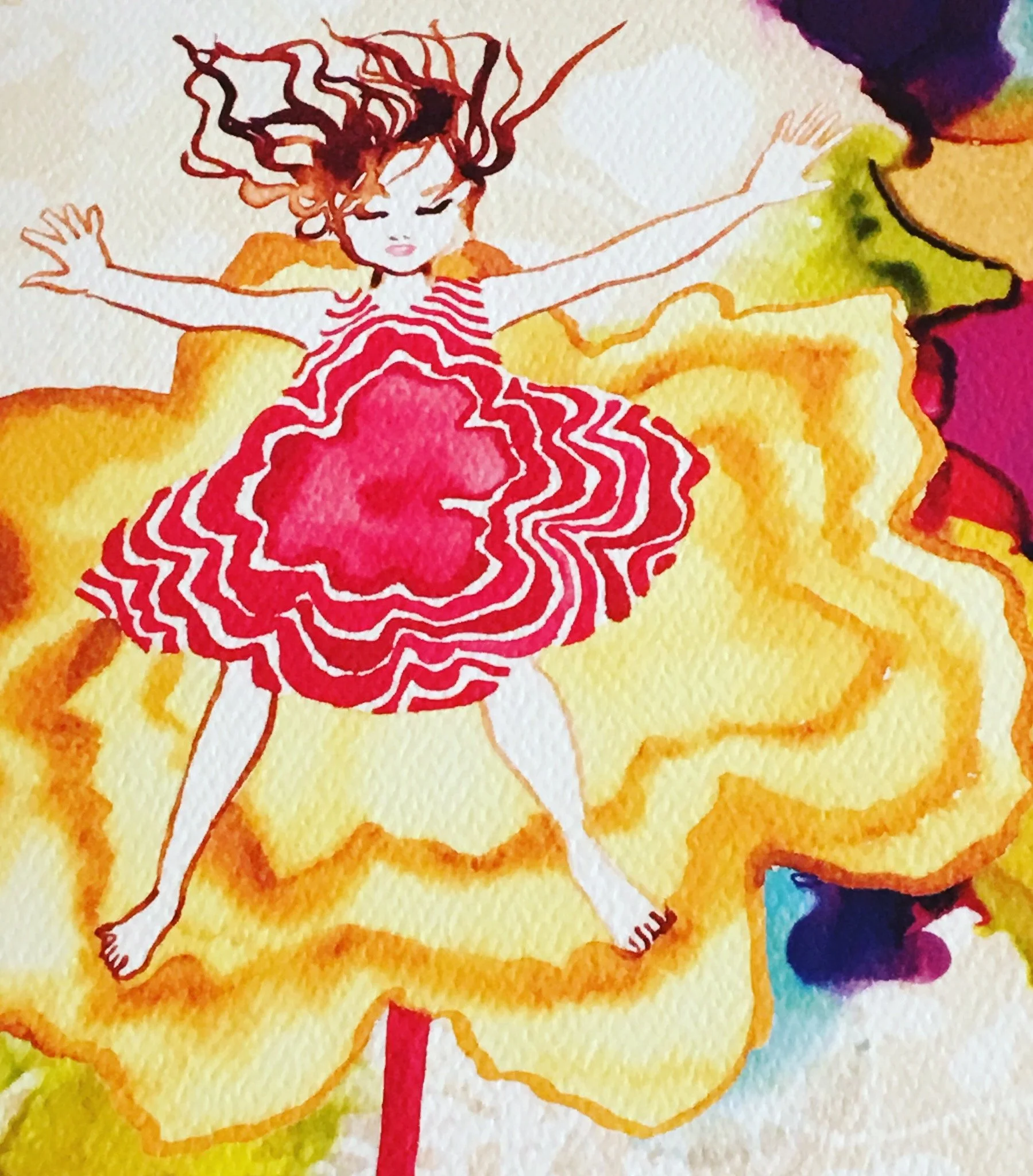
She is five now and has since performed in multiple shows and concerts at school, each time on her own terms. Everyone who knows her knows her rule, we as her parents aren’t allowed to watch her. She told us briefly once that when she sees us she thinks about us rather than what she’s supposed to do with her body. As we agree to sit in the audience and watch other children instead, she now draws herself on stage, smiling, wide eyed with eye lashes, a big smile, often a princess gown and crown, shining brilliantly.
Watching her draw those sad faces last year, I recognized what I had been circling around for two years but had not yet been able to name: containment through embodied inquiry.
As someone who has long studied how practitioners develop within their ecologies, how teaching shapes and is shaped by the systems, relationships, and practices surrounding it, I could not find the language to help me express the feeling of containment. The language I needed was not in education or teacher preparation, so I reached into psychoanalytic theory, Buddhist teaching, and contemplative practice the same way I had reached into nursing and social work years earlier to make a case for teacher wellbeing in early childhood special education (Gupta, 2020). My focus continues to be children's social emotional development, and what it means for adults to be regulated, to know ways to return to themselves in their bodies, so they can meet others there too.
The dictionary defines containment as the act or condition of containing (Merriam-Webster, 2024). Infant mental health offered a more precise definition: a child's capacity to experience and regulate emotions develops within the context of a caregiver who can receive what the child cannot yet hold, and return it in a form the child can manage (Osofsky & Thomas, 2012; Bion, 1962). Cooper (2025) asks what it costs to do that continuous emotional work when the work itself disappears behind the approval it receives, or when it's expected by adults. In caregiving professions this dynamic extends far beyond the therapeutic relationship: when practitioners end up absorbing more than they can process, the structure inverts, and the relational ethics of care collapse (Gabay & Ben-Asher, 2022). The same capacity infant mental health asks of caregivers requires that the caregiver first be able to meet herself in her own body.
Buddhist teaching holds a different image. Upekkha, equanimity, is one of the four brahmaviharas, the immeasurable qualities of the heart. It is the capacity to hold all sides of life in a caring embrace without being swept away by any of it (Wolf, 2024). Within the Plum Village tradition, upekkha is taught as the practice of inclusiveness, the ability to hold many perspectives, to stand firm and remain open at the same time (Lingo, 2022). It is also understood as resilience, the practice of holding your seat, responding mindfully rather than reacting habitually, staying present to what is actually happening (Nichtern, 2025). In this tradition the container is internal, cultivated through practice, and it belongs to the practitioner.
In the yogic tradition, svadhyaya, self-study, is one of the niyamas, the personal observances through which the practitioner cultivates the interior conditions for practice (Iyengar, 1993). The vessel is built through sustained, disciplined attention to oneself.
Knowing something in the body before it can be described, and creating space for that knowing in yourself and in the people you care for, is not preparation for the real work — it is the real work. Containment, across every tradition I draw on here, is an internal practice that belongs to the practitioner. I knew in my body that I could build the vessel in that dream through sustained attention to myself, and I choose to do that consciously, every day.
It has always struck me as curious that in teacher education, the body is considered a subordinate instrument, a tool for carrying forward the teachings of others rather than a source of our own wisdom, culture, and experience. Self-awareness is assumed. We are assumed to be in-tact vessels we interact with children, with families, and with our colleagues in early childhood settings. And yet vessel building is nowhere in our preparation. If it were, would we not encourage practitioners to explore which embodied movements are most helpful to them, the same way we encourage the children we work with to find their own?
Building and sustaining our individual vessels is a conscious practice that begins internally.
Pranayama taught me that the breath does not take care of itself. Yogasana taught me that the body does not simply open. I showed up, consistently, and paid attention to what it was telling me. The framework I am building for mapping embodied experience came from that same practice of sitting with what I noticed, returning to it without judgment, and creating space for language to emerge from what I was experiencing in motion (Gupta, 2025a; Gupta, 2025b).
In my own contemplative grounding, I am choosing to turn toward embodied inquiry to honor myself first as a necessary starting point for the relational work I do with teachers and learning communities, and because I want to know this practice from the inside out before I ask anyone else to enter it. The healing that often emerges in this process is not a destination. It is what becomes possible when you are willing to look at what you have been carrying (Jurow et al., 2025).
I continue to create spaces for our daughter to express what she is thinking and feeling. Mostly these spaces are unstructured and they begin with what I know she gravitates toward: art utensils, dance, running, open spaces where she can choose how her body moves rather than scheduled classes that dictate her movement.
Her second recital is approaching. We have front-and-center seats this time. I will have the sketchpad and click art pens ready for her to work through what she feels in her body during the rehearsal, which this year immediately precedes the recital. I do not know how it will go. What I know is that I am doing the work to meet myself first, so that I can meet her where she is then.
References
Bion, W. R. (1962). A theory of thinking. International Journal of Psycho-Analysis, 43, 306–310.
Cooper, A. (2025). Containment as a lived experience. Journal of Social Work Practice, 39(3).https://doi.org/10.1080/02650533.2025.2514408
Gabay, G., & Ben-Asher, S. (2022). An inverted container in containing and not containing hospitalized patients: A multidisciplinary narrative inquiry. Frontiers in Public Health, 10, Article 919516.https://doi.org/10.3389/fpubh.2022.919516
Gupta, S. S. (2020). Voices from the field: Why aren't we talking about teacher well-being with inclusion? Young Exceptional Children, 23(2), 59–62.https://doi.org/10.1177/1096250619846581
Gupta, S. S. (2025a). On self-knowledge: A framework for mapping moving meditations. Ecological Learning Partners.https://ecologicallearningpartners.com/blog/on-self-knowledge-a-framework-for-mapping-moving-meditations
Gupta, S. S. (2025b). A return to running. Ecological Learning Partners.https://ecologicallearningpartners.com/blog/practice-mapping-a-return-to-running
Gupta, S. S. (2026, January 9). Finding ground: From reactive accommodation to conscious positioning. Ecological Learning Partners.https://ecologicallearningpartners.com/blog/finding-ground-from-reactive-accommodation-to-conscious-positioning
Iyengar, B. K. S. (1993). Light on the Yoga Sutras of Patanjali. Thorsons.
Jurow, A. S., Mendoza, E., & Cortes, K. L. (2025). Can we design for healing in the learning sciences? Journal of the Learning Sciences.https://doi.org/10.1080/10508406.2025.2506346
Lingo, K. J. (2022). How equanimity powers love. Lion's Roar.https://www.lionsroar.com/how-equanimity-powers-love/
Merriam-Webster. (2024). Containment. In Merriam-Webster.com dictionary.https://www.merriam-webster.com/dictionary/containment
Nichtern, E. (2025, January 31). How mindfulness builds confidence. Lion's Roar.https://www.lionsroar.com/how-mindfulness-builds-confidence/
Osofsky, J. D., & Thomas, K. (2012). What is infant mental health? Zero to Three, 33(2), 9.https://www.zerotothree.org/wp-content/uploads/2022/06/Emerging-Issues-In-Infant-Mental-Health-12-Nov-Digital-Journal-Issue.pdf
Wolf, C. (2024, May 2). How to find balance through equanimity. Lion's Roar.https://www.lionsroar.com/equanimity-finding-better-balance/
Sarika S. Gupta, Ph.D., is the founder of Ecological Learning Partners LLC. She uses ecological mapping methodologies to understand complex educational systems, with particular expertise in early childhood education and teacher preparation.